BLS Structural Steel
Steel coating is more than colored paint on a structural surface. It is a carefully selected defense against moisture, oxygen, salts, chemicals, abrasion, and temperature changes. In practical terms, how coatings protect steel materials depends on the complete coating system, not one product alone. Surface preparation, primer selection, film thickness, curing, and inspection all influence performance.
Philip A. Schweitzer, a recognized corrosion engineer, described the problem clearly: “Corrosion is the destructive attack of a metal by chemical or electrochemical reaction with its environment.” A coating interrupts that reaction. It can form a physical barrier, reduce water and oxygen access, and sometimes provide sacrificial protection through zinc-rich primers. The result is not simply better appearance. It is slower corrosion, fewer repairs, and a longer service life for beams, tanks, bridges, and equipment.
Paint is not magic.
A tiny pinhole, damaged edge, or poorly cleaned weld can become a starting point for rust. Field inspectors often find failure beneath apparently sound surfaces, especially where salt remains trapped. This is why reliable coating work requires documented preparation, controlled application, and realistic maintenance planning. Standards such as ISO 12944 can guide system selection, but site conditions still demand judgment. A coastal structure does not face the same risks as an indoor warehouse.
The following guide explains coating types, protection mechanisms, application stages, common failures, and inspection practices. It also considers an uncomfortable truth: even an excellent coating eventually needs attention. That limitation should shape the design from the beginning.
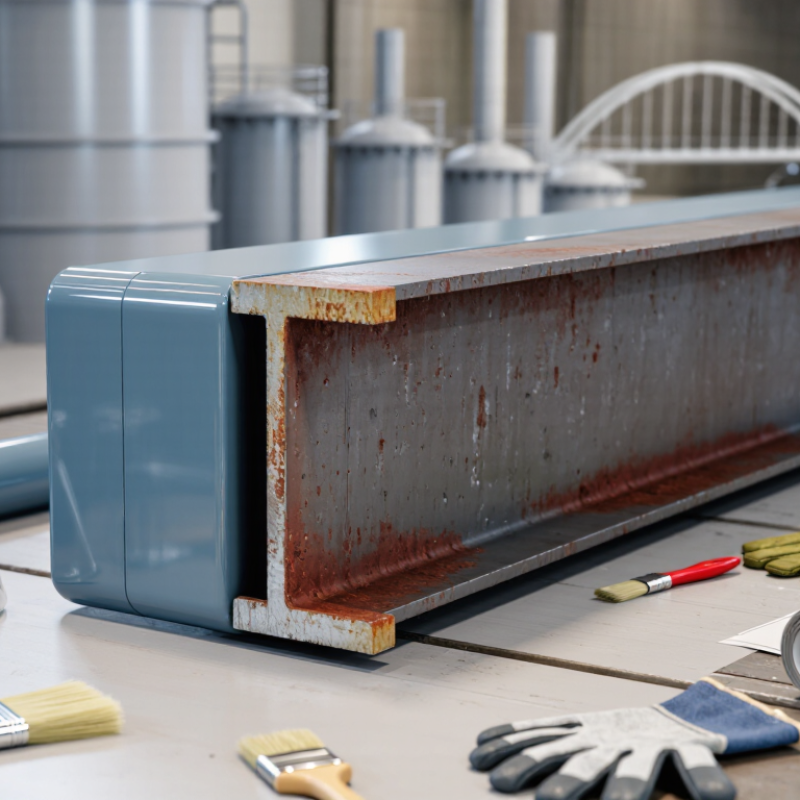
What Is Steel Coating and How Does It Protect?
What Steel Coating Is and Why It Matters
Steel coating is a designed layer placed between steel and its surroundings. It may contain zinc, epoxy, polyurethane, or other protective materials. The layer blocks water, oxygen, salts, and industrial chemicals from reaching the metal surface. Some coatings also provide cathodic protection, allowing zinc to corrode before exposed steel does.
The need is substantial. The AMPP IMPACT study estimated that corrosion costs about 3.4% of global gross domestic product, or roughly US$2.5 trillion annually. It also reported that 15–35% of corrosion costs could be reduced through better prevention and control. These figures explain why coating selection matters beyond appearance. A bridge near a coastline faces salt spray, while an indoor factory may face moisture, acids, or abrasion. The same coating cannot serve every environment well.
Protection depends on preparation, thickness, curing, and inspection. ISO 12944 links coating systems to atmospheric corrosivity, helping engineers match materials with real exposure conditions. Still, a specification alone cannot prevent failure. Practical inspections often find rust beginning at welds, sharp edges, bolt gaps, and accidental scratches. Small defects matter. A coating can look smooth and still contain pinholes or weak adhesion. Maintenance teams should record surface condition, dry-film thickness, and damaged areas rather than relying only on visual checks. The uncomfortable truth is simple: coating is not permanent protection. It is a managed system, and poor application can waste expensive steel.
Steel coating is more than paint spread across a grey surface. It is a designed interface between metal, moisture, oxygen, and mechanical stress. The 2016 IMPACT study reported that corrosion costs the global economy about US$2.5 trillion annually, equal to 3.4% of global GDP. Proper protection can reduce these costs by 15–35%, according to the same study.
Bonding begins with preparation. Abrasive blasting removes rust, mill scale, and weak residues from the steel. It also creates a controlled anchor profile, giving the coating microscopic valleys to grip. Cleanliness matters. Oil or soluble salts can remain invisible, yet later cause blistering and early delamination. Applicators also check steel temperature, humidity, and dew point before spraying. Small errors here become large failures later.
The liquid coating must wet the surface before it cures. Its resin then forms mechanical and chemical bonds with the prepared steel. Multiple layers may follow, with each film covering pores and reinforcing the previous layer. Zinc-rich systems provide additional protection through sacrificial action, while barrier layers block water and oxygen. ISO 12944-5:2018 classifies protective paint systems by environment and expected durability, helping engineers select suitable film thicknesses. Still, thickness alone is not protection. A thick film over contamination can fail faster than a thinner, well-bonded film. That assumption deserves testing. Field inspections should measure dry-film thickness, adhesion, pinholes, and damaged edges. Poorly coated edges often reveal the first signs of corrosion.
Steel coating is a protective layer applied to steel before service or during maintenance. It separates the metal from water, oxygen, salts, and industrial chemicals. Without that barrier, tiny scratches can become reddish corrosion spots, especially around welds and edges.
Hot-dip galvanizing coats steel with bonded zinc after immersion in molten zinc. It suits guardrails, structural frames, fasteners, and outdoor equipment because zinc provides barrier and sacrificial protection. Electroplated zinc is thinner and smoother, so it works well for indoor hardware and small components. Paint and liquid polymer systems offer flexible color choices for bridges, tanks, machinery, and building panels. Their performance depends heavily on surface preparation. Dust, oil, or trapped moisture can shorten service life.
Powder coating creates a tough, baked polymer film on prepared steel. It is common on furniture, cabinets, railings, and appliance parts. Thermal spray coatings, including zinc or aluminum, protect large structures that cannot enter a dipping bath. Conversion coatings improve paint adhesion and add mild corrosion resistance on sheets and precision parts. Field inspections reveal an inconvenient truth: even excellent coatings may fail at cut edges, bolt joints, or hidden crevices. Selection should consider exposure, temperature, abrasion, repair access, and maintenance needs. Thicker is not always better.
Steel coatings create a barrier against moisture, oxygen, salts, chemicals, and abrasion. The chart compares representative dry-film thicknesses for common coating systems; actual specifications vary by steel grade, exposure environment, and applicable standard.
Thicker coatings generally provide a longer diffusion path and more wear allowance, but coating chemistry, adhesion, surface preparation, and service conditions are equally important. Values shown are representative midpoints of commonly specified ranges.
Reference framework: typical ranges associated with ISO 1461, ASTM A123/A123M, ASTM B633, ISO 12944, and common powder-coating practice.
Steel coatings create a physical barrier between metal, moisture, oxygen, salts, and industrial chemicals. This barrier slows electrochemical corrosion before rust spreads beneath the surface. Some zinc-rich coatings provide sacrificial protection. Zinc corrodes first, protecting exposed steel around scratches and edges.
Wear protection works differently. A durable coating reduces friction, impact damage, and abrasion from sand, tools, or moving parts. Adhesion matters as much as hardness. Poor surface preparation can leave dust, oil, or mill scale beneath the film. I have seen small preparation errors become large maintenance problems. The coating was not always the real failure.
The NACE IMPACT study estimated that corrosion costs about 3.4% of global GDP, or roughly 2.5 trillion US dollars annually. It also reported that 15–35% of corrosion costs could be avoided through better practices. Those figures show why coating selection deserves engineering review, not guesswork.
Clean steel to the specified preparation grade. Check surface salts, humidity, and steel temperature before application. Measure dry-film thickness after curing. Pay extra attention to welds, corners, and bolt heads. A single thickness reading can mislead. Use several readings across the structure. Reinspect damaged areas early, even when rust looks minor.
Steel coating forms a barrier between the metal surface and corrosive agents. Water, oxygen, salts, and industrial chemicals can penetrate weak areas. The NACE IMPACT study estimated global corrosion costs at US$2.5 trillion annually, or about 3.4% of global GDP. It also reported that 15% to 35% of corrosion costs could be avoided through better practices. Preparation matters.
Surface cleanliness strongly affects coating adhesion and service life. Rust, oil, mill scale, and soluble salts can create hidden failure points. Abrasive blasting, surface profiling, and dust testing must match the selected coating system. ISO 12944 emphasizes environmental exposure, including humidity, salinity, pollution, and immersion conditions. A coating designed for a dry warehouse may fail quickly near a coastline.
Film thickness also matters. Too little coating leaves weak coverage, while excessive thickness can cause cracking or solvent entrapment. Application temperature, curing time, mixing accuracy, and spray technique influence the final film. Sharp edges and welds deserve special attention because coatings become thinner there. Moisture is unforgiving. Regular inspections can detect blistering, rust staining, pinholes, and adhesion loss before repairs become expensive. Yet field conditions rarely match laboratory panels. That assumption can fail. Maintenance records, exposure history, and honest inspection notes often predict performance better than appearance alone.
| Coating System | Primary Protection Mechanism | Typical Dry Film Thickness | Suitable Exposure | Important Performance Factors | Indicative Service-Life Range |
|---|---|---|---|---|---|
| Hot-dip galvanized zinc coating | Provides a barrier layer and sacrificial cathodic protection when exposed steel is connected to zinc. | Approximately 45–200 µm, depending on steel thickness and coating specification. | Outdoor atmospheric, industrial, rural, and many marine environments. | Zinc thickness, surface cleanliness, chloride or sulfur dioxide levels, wetness, drainage, and contact with dissimilar metals. | About 10–70+ years, depending strongly on atmospheric corrosivity and zinc loss rate. |
| Zinc-rich primer system | Combines barrier protection with sacrificial protection when sufficient electrically conductive zinc is present. | Approximately 50–100 µm for the primer layer. | Atmospheric steelwork, including industrial and coastal structures when properly overcoated. | Zinc loading, surface preparation, application humidity, curing, dry film thickness, and compatibility with intermediate coats. | Approximately 8–25 years before major maintenance in moderate-to-severe atmospheric exposure. |
| Epoxy barrier coating | Creates a dense barrier that limits water, oxygen, and ionic contaminants from reaching the steel surface. | Approximately 100–300 µm per coat or system layer, depending on specification. | Industrial, chemical, immersion, and high-moisture service when the formulation is suitable. | Surface profile, cleanliness, pinholes, edge coverage, curing temperature, chemical compatibility, and ultraviolet exposure. | Approximately 5–15 years in atmospheric service; shorter if exposed directly to sunlight without a UV-resistant topcoat. |
| Polyurethane topcoat | Adds weather, color, gloss, and ultraviolet resistance over a compatible primer or intermediate coat. | Approximately 40–75 µm per coat. | Exterior atmospheric exposure where appearance and UV resistance are important. | Underlying coating condition, film thickness, UV intensity, weathering, recoating interval, and application conditions. | Approximately 5–15 years before significant aesthetic or protective maintenance, depending on exposure. |
| Thermal-sprayed zinc or zinc-aluminum | Provides a metallic barrier and sacrificial protection; sealing can reduce porosity and extend durability. | Approximately 100–250 µm, commonly followed by a sealer or paint system. | Large fabricated structures, bridges, offshore components, and repair work where dimensional limitations apply. | Surface blast profile, coating uniformity, porosity, sealing, access, spray parameters, and local damage. | Approximately 15–40+ years in atmospheric exposure when correctly applied and maintained. |
| Duplex system: zinc coating plus paint | Combines the barrier and sacrificial protection of zinc with the sealing and weather resistance of paint. | Zinc layer typically 45–200 µm, plus approximately 120–300 µm of paint system. | Severe atmospheric, coastal, industrial, and visually demanding applications. | Adhesion between layers, surface preparation, compatible paint chemistry, edge detailing, impact damage, and inspection. | Often 1.5–2.5 times the expected life of the individual systems, subject to environment and maintenance. |
| Factor | How It Affects the Coating | Recommended Control or Check |
|---|---|---|
| Surface preparation | Oil, rust, mill scale, salts, and dust can reduce adhesion and accelerate underfilm corrosion. | Use the specified cleaning grade, abrasive profile, dust removal, and soluble-salt inspection method. |
| Coating thickness | Insufficient thickness shortens protection; excessive thickness may cause cracking, solvent entrapment, or poor curing. | Measure dry film thickness using calibrated instruments and follow the specified minimum and maximum values. |
| Moisture and temperature | Condensation, rain, low temperature, or high humidity can impair curing and cause blistering or flash rust. | Monitor steel temperature, air temperature, relative humidity, and dew point during application. |
| Environmental corrosivity | Chlorides, sulfur dioxide, industrial pollutants, marine spray, and persistent wetness increase corrosion rates. | Select the coating system and thickness according to the site corrosivity category and exposure conditions. |
| Design and drainage | Sharp edges, crevices, lap joints, and water traps create weak points and localized corrosion cells. | Use rounded edges, continuous welds where appropriate, drain holes, accessible surfaces, and stripe coats. |
| Mechanical damage | Impact, abrasion, cutting, and installation damage can expose steel and initiate localized corrosion. | Protect coated components during handling and repair damaged areas using an approved touch-up procedure. |
| Inspection and maintenance | Early detection of rusting, blistering, chalking, cracking, and delamination prevents larger failures. | Establish routine visual inspections, thickness checks, defect mapping, cleaning, and timely recoating. |
Note: Service-life values are indicative ranges for properly specified, applied, inspected, and maintained systems. Actual performance depends on the exposure environment, design, coating quality, and maintenance schedule.
Steel coating is a protective layer placed between steel and its surroundings. It blocks water, oxygen, salts, and chemicals. The layer is not permanent.
It creates a barrier against moisture and corrosive substances. Zinc coatings can corrode first, protecting exposed steel. That protection weakens after damage.
Coastal structures face salt spray and constant moisture. Factories may expose steel to acids, heat, or abrasion. Indoor steel usually needs different protection.
Common choices include hot-dip zinc, electroplated zinc, paint, polymers, powder coating, and thermal spray. Each suits different sizes, exposures, and repair conditions. One coating cannot fit every project.
It suits guardrails, structural frames, fasteners, and outdoor equipment. Molten zinc forms a bonded protective layer around the steel. Edges still deserve careful inspection.
Powder coating creates a baked polymer film on prepared steel. It often protects furniture, cabinets, railings, and appliance parts. Poor preparation can shorten its service life.
No. Thickness alone does not guarantee durability. Poor adhesion, trapped moisture, or weak curing can cause early failure. More material is not always wiser.
Inspect welds, sharp edges, bolt gaps, cut edges, and hidden crevices. Scratches and pinholes can start small corrosion spots. Smooth appearance can mislead.
Remove dust, oil, rust, and trapped moisture before application. The surface should match the coating system’s requirements. Preparation is often underestimated.
Record surface condition, coating thickness, damaged areas, and repair dates. Check scratches before reddish corrosion spreads. Visual checks alone are imperfect.
Steel coating is a protective layer applied to a metal surface to improve its durability, appearance, and resistance to environmental damage. It matters because untreated steel can react with moisture, oxygen, chemicals, friction, and changing temperatures, leading to corrosion, surface wear, and reduced structural strength. Coatings bond to steel through methods such as chemical adhesion, mechanical attachment, or heat-assisted fusion, creating a continuous barrier that covers exposed areas and helps seal vulnerable points.
Different coating types serve different purposes, including protective paints, metallic layers, powder coatings, and specialized finishes for high-wear or high-temperature conditions. Understanding how coatings protect steel materials involves examining how they block water and oxygen, resist chemical attack, reduce friction, and prevent direct contact between steel and damaging surroundings. Performance depends on surface preparation, coating thickness, application quality, curing conditions, operating temperature, and exposure to moisture or abrasion. With proper selection, installation, inspection, and maintenance, a steel coating can significantly extend service life and reduce repair requirements.
